
Why Contractors Without a Clear Online Presence Compete Only on Price
- Feb 18
- 4 min read
In the construction and remodeling industry, skill alone no longer determines success. Two contractors can provide similar quality, experience, and outcomes, but one secures premium rates while the other slashes prices to win bids. The critical difference lies in positioning. Without a clear, structured online presence, your business seems interchangeable, pushing you into price-based competition despite superior work.
Perception Determines Pricing Power
Homeowners and general contractors evaluate your business based on its initial online impression, not hidden standards or expertise. A fragmented presence, such as sporadic Facebook updates or mismatched branding, conveys informality and unreliability. This encourages clients to compare options, haggle fiercely, and prioritize the cheapest quote.
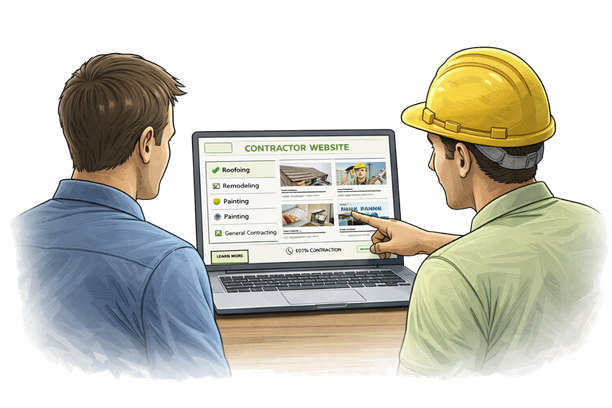
A structured website with precise messaging, dedicated service pages, and uniform branding transforms perceptions to professional and dependable. Discussions evolve from cost-cutting to project timelines. Statistics reveal that 91 percent of homeowners consider online reviews crucial when selecting contractors, with 56 percent checking Google first and 51 percent visiting the contractor's site directly. Additionally, 96 percent expect a user-friendly, professional website, and 80 percent weigh online booking options in their decisions. Without these elements, opportunities depend on undercutting competitors.

The Commodity Trap
Lacking unique positioning traps contractors in commodity status, where services appear identical and price rules. Vague statements like quality work or free estimates fail to stand out. Isolated job images lack differentiation.
Effective online positioning emphasizes your distinct methods, target clients, and procedures, redirecting focus to value. Branded contractors experience elevated conversion rates and reduced price pushback, according to industry benchmarks. For instance, the remodeling market reached 164.5 billion dollars in 2025, yet undifferentiated players struggle with thin margins.
Premium Is a Perception Before It Is a Price
Higher pricing originates from digital portrayal, not solely superior materials or elite areas. An orderly online image lowers apparent risk, supporting elevated fees. In remodels, clients purchase assurance and dependability.
Contrast two profiles: one features a polished site with service details, visual portfolios, endorsements, and workflow explanations; the other offers merely an Instagram description noting licensed and insured, contact for estimate. The former justifies premiums through pre-established worth. Data indicates high-trust firms in construction achieve 57 percent repeat business and up to 4 million dollars in annual savings from efficiency.
Inconsistent Online Presence Signals Instability
General contractors investigate online before contact. Gaps, outdated content, or absent sites imply transient operations. Reliable partners favor steady, expert subcontractors for superior assignments.
This positioning unlocks higher-profit opportunities, distancing from bid wars. Studies show 85 percent of service searches start online, underscoring the need for robust visibility.
Social Media Alone Is Not Positioning
Platforms like Facebook enhance exposure but lack stability. Content fades, discussions bury, algorithms fluctuate. They serve dialogue, not authority.
A website centralizes your operations, detailing offerings, clarifying methods, and contextualizing projects. Transitioning from social to site reinforces purposefulness, boosts SEO for queries like kitchen remodeler nearby, and yields price-resilient traffic. Contractors report 400 to 450 percent ROI from content marketing when integrated with sites.
Clear Structure Creates Value Clarity
Explicit services, locations, and steps render pricing logical. Clients grasp inclusions, viewing deliverables over figures. In fluctuating-cost sectors like remodeling, this pivots emphasis to benefits.
Industry data highlights minor kitchen remodels yielding 107.2 percent ROI at resale, demonstrating perceived value's impact.

Long-Term Businesses Position Differently
Sustainable operations prioritize enduring online assets that accrue credibility and recognition. Transient players chase deals via cuts; veterans capitalize on positioning for superior returns.
Construction firms with strong branding secure 2 to 7 percent higher margins.
Industry Trends Reinforcing the Need for Digital Positioning
The remodeling sector projects growth to 509 billion dollars in 2025 for owner-occupied homes, with total market surpassing 600 billion. High interest rates foster stay-in-place renovations, where 90 percent hire pros for major work. Kitchen and bath dominate at 235 billion dollars, while exteriors offer over 200 percent ROI. Labor shortages cost 10.8 billion annually but eliminate low-end rivals, favoring positioned contractors. Digital trends show 65 percent using search engines for research, with 49 percent specifically hunting builders online.
Case Studies: Real Transformations from Enhanced Online Presence
Consider Ayars Complete Home Improvements, a remodeling contractor who refined their digital strategy. By optimizing their Google Business Profile, adding hyperlocal content, and incorporating social proof, they balanced lead quality and quantity, attracting ideal projects.
Another example: Mariano and Company invested in a new SEO-optimized site and reputation management. Within six months, they generated 392 high-value leads, leveraging their established reputation.
A local remodeler implemented a fully-managed system including website management, listings, and SEO. This yielded over 341 leads, demonstrating integrated digital efforts' power. These cases illustrate how targeted improvements deliver measurable growth, with average digital marketing ROI at 280 to 350 percent.
Common Myths About Online Presence for Contractors
Myth: Word-of-mouth suffices. Reality: 92 percent research businesses online before engaging, and 71 percent of commercial buyers start digitally.
Myth: Websites are optional. Reality: 62 percent ignore businesses without one, and professional sites are expected by 96 percent.
Myth: Social media replaces sites. Reality: Sites anchor authority, with SEO delivering 681 percent ROI long-term.
How to Break Free from Price-Only Competition: Practical Steps
Transition to premium through these measures:
Develop or enhance a professional website: Ensure mobile optimization, quick loads, client orientation. Incorporate service specifics, process descriptions, contextual galleries, testimonials, and forms.
Articulate unique value: Detail specialties, methodologies, warranties, or preferred clients.
Refine local SEO: Secure Google Business Profile, collect reviews, produce localized content.
Display evidence: Employ videos, narratives, case studies.
Ensure uniformity: Harmonize branding and messaging across channels.
Promote testimonials: Solicit from content clients for credibility.
These actions produce rapid gains affordably, with costs per lead averaging 80 to 120 dollars.

Final Thought
Price battles stem from seeming substitutable. Commit to distinct positioning and digital assets to draw trust-oriented clients. In construction, excellence forges reputation; positioning converts it to pricing authority and expansion.
Fortify your online foundation this week for enhanced profitability.


Comments